


A good voice can make a big difference in how people experience a video, advertisement, online course, podcast, or business presentation. The right narration helps explain information, keeps the audience interested, and gives content a more professional feel.
But creating a voiceover is not always as simple as recording a few sentences. You may need to write a script, find a suitable speaker, arrange a recording session, edit the audio, and make changes when something needs to be updated.
Today, AI voice generators offer another way to create spoken audio. Instead of hiring someone to record every line, you can enter written text into a text-to-speech tool and generate narration using an AI voice.
This has created an important question for content creators and businesses: Should you use an AI voice generator or hire a human voice actor?
The answer depends on your project. AI voices can be useful when you need regular narration, multiple versions, or frequent content updates. Human voice actors may be a better choice when a project requires a distinctive performance, strong emotional expression, or a personal connection with the audience.
In this guide, we will compare AI voice generators and human voice actors in terms of cost, sound quality, production time, flexibility, and practical use cases. We will also explain how to choose the right option for your next voiceover project.
What is an AI Voice Generator?
An AI voice generator is a tool that converts written text into spoken audio using artificial intelligence and text-to-speech technology.
You provide a script, select an available voice, and generate an audio recording. Depending on the tool, you may also be able to choose a language, adjust speaking speed, or use other voice settings.
For example, imagine that you run a website and regularly publish educational videos. You have written a script explaining how a particular software feature works. Instead of recording the narration yourself, you can enter the script into an AI text-to-speech tool and generate a voiceover.
The generated audio can then be added to your video using a separate editing tool.
How does AI voice generation work?
A typical process includes the following steps:
- Text input: You prepare and enter the written script.
- Voice selection: You choose an available AI voice and supported language.
- Text processing: The system analyses the text and prepares it for speech.
- Audio generation: The AI model produces spoken audio.
- Audio review: You listen to the result and check pronunciation, clarity, and pacing.
- Final use: You add the generated audio to your video, presentation, or other content.
Modern AI voice technology can produce speech with more natural pronunciation and rhythm than older computer-generated voices. Some systems also offer expressive speech styles and additional controls.
However, results vary between tools and voices. A generated voice may still sound unnatural in certain sentences, mispronounce technical words, or fail to deliver the intended emotion.
AI voice generation is also different from AI voice cloning. A standard AI voice generator uses an available synthetic voice, while voice cloning attempts to reproduce characteristics of a particular person’s voice. Voice cloning requires additional attention to consent, privacy, and usage rights.
Who is a Human Voice Actor?
A human voice actor is a professional speaker who uses their voice to communicate a script for a particular purpose.
Voice actors work on different types of projects, including:
- Advertisements and promotional videos
- Animation and character voices
- Audiobooks
- Documentaries
- Corporate presentations
- Online courses
- Video games
- Explainer videos
- Radio and television commercials
Unlike a text-to-speech system, a human voice actor performs the script. They can interpret the meaning, understand the intended audience, and change their delivery according to the context.
For example, consider a promotional video for a new product.
The script may contain the sentence:
“Discover a simpler way to manage your daily work.”
A voice actor can deliver this sentence with excitement, confidence, warmth, or a calm professional tone depending on the brand’s requirements.
A professional recording may also include direction from a producer or client. The voice actor can record alternative versions, adjust individual lines, and repeat sections until the delivery matches the brief.
This level of performance and direct creative control is one of the main reasons businesses continue to hire human voice artists.
AI Voice Generator vs Human Voice Actor: Key Differences
Both options can produce narration, but the way they work is different.
Here is a quick comparison of their main features.
| Factor | AI voice generator | Human voice actor |
|---|---|---|
| Voice creation | Generates speech from written text | Performs and records the script |
| Production process | Usually starts with text and voice selection | Requires a recording session |
| Speed | Can generate prepared text quickly | Depends on availability and recording schedule |
| Voice options | Depends on the voices available in the tool | Depends on the talent you hire |
| Emotional delivery | Varies by model and available controls | Can offer nuanced human performance |
| Pronunciation | May need checking and corrections | Can take direction on pronunciation |
| Revisions | Text can be edited and regenerated | Changes may require additional recording |
| Consistency | Can maintain a selected synthetic voice across files | Depends on the same speaker and recording conditions |
| Creative direction | Limited to the tool’s supported controls | More direct performance and delivery control |
| Best suited for | Repeated narration and routine content | Projects requiring a specific human performance |
Neither option is automatically better for every project.
For example, a business that produces hundreds of short product explanations may find AI narration convenient. A company launching a major television advertisement may prefer a professional voice actor who can deliver a specific brand personality.
The important point is to compare the requirements of the project rather than choosing a voice based only on technology or price.
AI Voice vs Human Voice: Which Sounds Better?
Voice quality is one of the most important factors when choosing between AI narration and human recording.
However, sound quality is not just about whether a voice sounds realistic. It also includes pronunciation, clarity, pacing, expression, consistency, and how well the voice suits the content.
1. Naturalness
Human voices naturally include small changes in rhythm, tone, emphasis, and expression.
AI voices have improved significantly, and some can sound natural in many everyday situations. However, certain voices may still have difficulty with unusual phrases, complicated sentences, or unexpected changes in emotion.
For a straightforward tutorial, the difference may not be a major issue. For a dramatic story or emotional advertisement, the performance may matter much more.
2. Emotional expression
Human voice actors can interpret the script and deliver it according to the situation.
For example, a voice actor narrating a charity campaign may understand when to use a gentle, serious, or emotional tone.
AI systems may offer expressive controls, but their ability to communicate complex emotions depends on the specific model and available features.
3. Pronunciation and clarity
Both AI and human voices can make pronunciation mistakes.
An AI system may pronounce a company name or technical term incorrectly. A human voice actor may also need guidance when reading unfamiliar words.
The difference is that a human performer can receive direct instructions during recording. With AI narration, you may need to adjust the written text or use pronunciation features if available.
4. Voice consistency
Consistency is particularly important when creating a large collection of content.
For example, a business may publish product tutorials every week. Using the same AI voice can help maintain a similar sound across multiple recordings.
A human voice actor can also provide consistency, especially when the same person records the complete project. However, differences in recording conditions, performance, or availability may affect later sessions.
Comparing the Cost of AI Voiceovers and Human Voice Actors
Cost is often one of the first things people consider when choosing a voiceover solution.
However, the total cost depends on more than the price of generating audio or hiring a speaker.
You should consider the amount of content, number of revisions, licensing, editing, production requirements, and how often the audio needs to be updated.
How much does an AI voice generator cost?
AI voice tools may use different pricing models, such as:
- Monthly subscriptions
- Pay-as-you-go usage
- Character or word limits
- Credit-based plans
- Different plans for personal and commercial use
The exact cost depends on the provider and the features included in the selected plan.
For someone creating regular narration, a subscription may be convenient. For occasional projects, a usage-based option may be more suitable.
Before choosing a tool, check whether its plan covers your expected audio usage, commercial rights, download options, and other required features.
How much does a human voice actor cost?
Human voiceover pricing can vary considerably.
Some voice actors charge per word, while others charge per finished minute, project, session, or recording hour.
The price may also depend on:
- Experience and professional reputation
- Type of project
- Script length
- Recording quality
- Number of revisions
- Usage rights and licensing
- Advertising or broadcast distribution
- Exclusivity requirements
- Additional production services
A short internal training video may require a different budget from a national advertising campaign.
There is no single standard price that applies to every voice actor or project.
Example: Comparing the overall production process
Imagine a business needs narration for 20 short training videos.
With an AI voice generator, the team may prepare scripts, generate the audio, review it, and edit the videos internally.
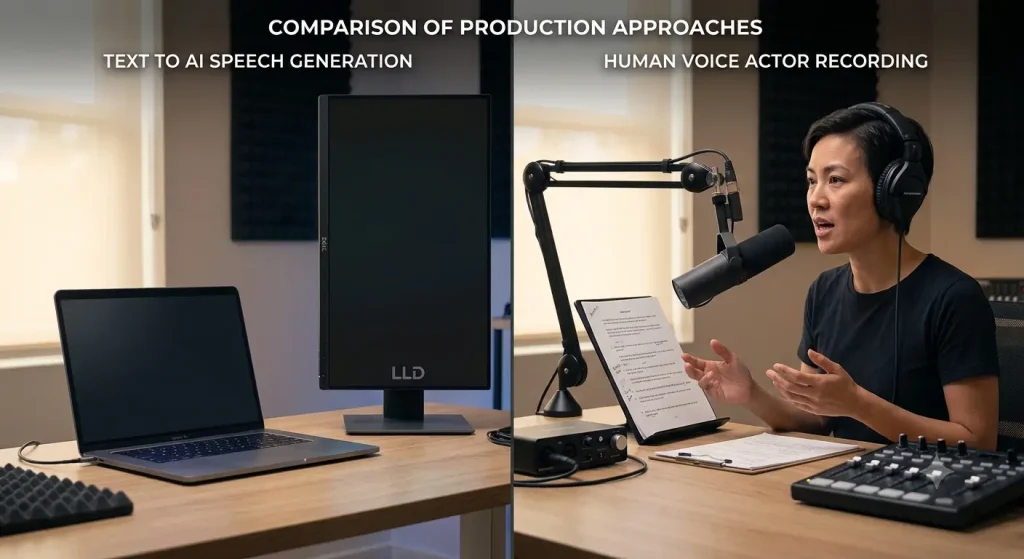
With a human voice actor, the team may need to arrange recording sessions, provide direction, review recordings, and request additional takes when changes are necessary.
The AI option may reduce some production costs and coordination, particularly when scripts change frequently. However, it still requires someone to prepare the content, check the audio, and produce the videos.
The human option may involve a larger production budget, but it can provide a performance that better matches the project’s creative requirements.
Which option is more cost-effective?
AI voice generation may be more cost-effective when:
- You produce a large amount of routine narration.
- You need frequent content updates.
- You create multiple versions of the same material.
- You can handle editing and quality checks internally.
Human voice actors may be worth the investment when:
- The voice is central to the brand identity.
- The project requires a distinctive performance.
- Emotional delivery is important.
- Professional direction and recording quality are essential.
Do not compare only the initial price. Consider the complete cost of producing, reviewing, updating, and using the final audio.
Production Time and Workflow Differences
Time is another important difference between AI voice generation and human voice recording.
AI voice generation workflow
A typical AI voiceover workflow looks like this:
- Prepare the script.
- Select a voice and language.
- Generate the audio.
- Review the pronunciation and delivery.
- Correct any issues.
- Export or use the audio in your project.
For prepared scripts, audio generation can be quick. However, the complete process still takes time because scripts need to be checked and generated audio needs to be reviewed.
Human voice recording workflow
A typical human recording workflow may involve:
- Prepare the script and creative brief.
- Find and select a suitable voice actor.
- Discuss the intended audience and delivery style.
- Arrange a recording session.
- Record the narration.
- Review the recording.
- Request changes or additional takes.
- Edit and finalize the audio.
The timeline depends on the voice actor’s availability, project complexity, and revision requirements.
What happens when the script changes?
This is where the difference can become especially noticeable.
Suppose a software company changes the name of a feature in its application. The company has already created 15 tutorial videos, and the old feature name appears in several narrations.
With AI narration, the team can update the affected text and generate replacement audio.
With a human voice actor, the company may need to arrange another recording for the changed lines. The actor may also need to match the original recording style.
Both options require the video or audio editor to replace the affected sections and check synchronization.
Where AI Voice Generators Work Best
AI voice generators are useful for many types of content, especially when the main requirement is clear and consistent narration.
Here are some common examples.
1. YouTube educational videos
Creators who regularly publish educational videos can use AI narration for explanations, tutorials, and informational content.
For example, a channel about technology may publish weekly videos explaining new software features.
An AI voice generator can help create narration from prepared scripts without requiring a new recording session for every video.
The creator should still review the final audio and ensure that the voice suits the channel’s style.
2. Product demonstrations
Businesses often need to explain how their products or services work.
AI narration can be used for:
- Product introductions
- Feature explanations
- Software walkthroughs
- Setup instructions
- Frequently asked questions
This is particularly useful when the same explanation needs to be adapted for different products or audiences.
3. E-learning and training content
Online educators and businesses can use AI voices for course narration, employee onboarding, and training presentations.
A consistent voice can help maintain a similar style across multiple lessons.
For important training topics, subject experts should review the script and final narration.
4. Business presentations
A presentation may need narration when it is shared with employees, clients, or other stakeholders.
AI-generated audio can provide spoken explanations for slides and recorded presentations.
However, if the presentation represents senior leadership or communicates an important personal message, a real speaker may be more appropriate.
5. Website and informational content
Some websites publish audio versions of educational articles, instructions, or informational material.
Text-to-speech can help convert written content into spoken audio, giving visitors another way to access the information.
The website owner should make audio controls easy to find and avoid automatically playing narration.
When Should You Hire a Human Voice Actor?
Although AI voice generation is useful, there are projects where human performance remains especially valuable.
1. Emotional storytelling
Stories often depend on subtle changes in tone, timing, and expression.
A human voice actor can interpret the story and adjust their delivery to communicate sadness, excitement, tension, warmth, or humour.
This can be important for documentaries, personal stories, charity campaigns, and narrative videos.
2. Television and radio advertising
Advertising often needs a distinctive voice that matches the brand’s personality.
A human performer can take direction from the creative team and deliver different versions of the same line.
For campaigns where the voice itself is a major part of the creative identity, hiring a professional may be worthwhile.
3. Animation and character performances
Animated characters often need unique personalities.
A voice actor can create different ways of speaking, reacting, laughing, and expressing emotion. This type of performance may require more than reading a written script.
4. Audiobooks and dramatic narration
Some audiobooks are straightforward informational recordings, while others involve multiple characters, storytelling, and emotional scenes.
Human narrators can bring their interpretation and performance skills to these projects.
AI narration may still be suitable for some informational or draft audio uses, but the requirements of the final audiobook should guide the decision.
How Speakatoo Can Help with AI Voice Generation
Speakatoo provides text-to-speech functionality that can help convert written scripts into spoken audio. This can be useful for creators and businesses preparing narration for educational videos, tutorials, presentations, and other informational content.
You can explore the Speakatoo Text to Speech tool to learn more about its available voice-generation options.
A simple workflow with Speakatoo
You can follow this process when preparing AI narration:
- Write and review your voiceover script.
- Open the Speakatoo text-to-speech tool.
- Select an available voice and supported language.
- Enter the text you want to convert into speech.
- Generate the audio.
- Listen to the result and check pronunciation and clarity.
- Make changes if required.
- Use the generated audio in your video editor, presentation, or other content.
For example, a creator preparing a series of technology tutorials can write a separate script for each video and generate narration for the individual lessons.
This can help maintain a consistent narration workflow without arranging a new recording session for every update.
However, AI voice generation does not replace the complete production process. You will still need to prepare the script, review the audio, edit the video if required, and publish the final content through the appropriate platform.
The best approach is to choose the voice-generation method that meets your project’s actual needs rather than using AI or human recording simply because one option is more popular.
Frequently Asked Questions
1. What is the difference between an AI voice generator and a human voice actor?
An AI voice generator converts written text into spoken audio using text-to-speech technology. A human voice actor performs and records the script. AI can be convenient for routine narration, while human performers can offer direct creative interpretation and emotional expression.
2. Are AI voices better than human voices?
Not in every situation. AI voices can work well for tutorials, informational videos, and frequently updated content. Human voices may be more suitable for storytelling, advertisements, and projects requiring a specific performance. The right option depends on the project.
3. Is an AI voice generator cheaper than hiring a voice actor?
AI voice generation can be more economical for some projects, especially when you need large amounts of narration or frequent updates. However, the total cost depends on tool pricing, usage limits, licensing, editing, and production requirements. Human voice actors have their own pricing based on experience, project type, and usage rights.
4. Can AI voices sound like real people?
Some AI-generated voices can sound quite natural, with realistic pronunciation and speech patterns. However, quality varies between tools and voices. A natural-sounding voice may still need adjustments when reading technical terms or delivering emotional content.
5. Can I use AI-generated voices for YouTube videos?
Yes. AI-generated narration can be used in YouTube videos, including tutorials, explainers, and educational content. You should review the audio, follow the voice provider’s usage terms, and comply with the platform’s applicable content and disclosure requirements.
6. When should I hire a professional voice actor?
Consider hiring a professional when your project requires emotional storytelling, character performance, a distinctive brand voice, detailed creative direction, or a personal connection with the audience.
7. Can AI voice generators create audio in multiple languages?
Some AI voice generators support multiple languages. However, language availability and pronunciation quality vary. Always check the supported languages and review the generated audio, particularly when using regional expressions, technical terms, or mixed-language scripts.
8. Can I use both AI voices and human voice actors in one project?
Yes. You can use a human voice actor for important introductions, storytelling, or brand messages and AI narration for routine explanations, supplementary lessons, or frequent updates. A combined approach can offer flexibility while maintaining human performance where it matters.
9. Is AI voice cloning the same as text-to-speech?
No. Text-to-speech converts written text into spoken audio using an available synthetic voice. Voice cloning attempts to reproduce the characteristics of a particular person’s voice. Cloning requires appropriate permission and careful consideration of privacy and usage rights.
10. Do AI voice generators need audio editing?
It depends on the project and the quality of the generated audio. You may need to trim sections, adjust volume, add pauses, or synchronize the narration with video. A simple voiceover may need very little editing, while a professional production may require more work.
Final Thoughts
AI voice generators and human voice actors both have an important place in modern content production.
AI narration can be a practical choice for tutorials, product explanations, online learning, and other projects that need clear and consistent speech. It can also make script updates and repeated voiceover production more convenient.
Human voice actors remain valuable when a project needs emotional expression, storytelling, character performance, or a distinctive personal delivery.
There is no need to treat these options as competitors in every situation. Some projects benefit from AI, others need a human performer, and some work best with a combination of both.
Before choosing, consider your audience, content type, budget, production schedule, and quality requirements. If you are unsure, test the same short script using an AI voice and a human recording. Comparing the actual results will help you make a more informed decision.
Ultimately, the best voiceover is not simply the one that costs less or sounds more realistic. It is the one that communicates your message clearly and gives your audience the experience your content is meant to provide.