


Introduction
Video content is no longer limited by the language in which it was originally created. A creator in India can publish a video in Hindi and reach viewers in the United States, Japan, France, or Brazil. A business can create one product video and adapt it for several markets. An educator can turn a single lesson into content that students can understand in different languages.
One technology helping make this possible is AI dubbing.
AI dubbing uses artificial intelligence to translate spoken content into another language and generate a new voice track for the video. Modern systems are also becoming better at preserving the speaker’s tone, timing, emotion, and speaking style instead of simply translating words and reading them aloud.
This shift is happening quickly in 2026. YouTube has expanded its automatic dubbing system to 27 languages, while its expressive-speech technology is available for selected languages to make dubbed speech sound more natural. YouTube also reported that more than 6 million daily viewers watched at least 10 minutes of auto-dubbed content in December.
For creators, marketers, educators, and businesses, this means a video made for one audience can increasingly become a multilingual piece of content without recording every version from scratch.
But what exactly is AI dubbing, how does it work, and can it really replace traditional dubbing?
Let’s take a closer look.
What is AI Dubbing?
AI dubbing is the process of using artificial intelligence to create a translated voice track for an existing video or audio file.
A traditional dubbing process usually requires several people, including translators, voice actors, directors, editors, and audio engineers. The process can take considerable time, especially when a video needs to be released in many languages.
AI dubbing automates many of these steps.
A typical AI dubbing workflow looks like this:
Original Video → Speech Recognition → Translation → Voice Generation → Timing & Audio Processing → Dubbed Video
The system first identifies what the original speaker is saying. It then translates the dialogue into the target language and generates speech in that language.
More advanced systems can also identify different speakers and attempt to preserve characteristics of the original performance.
Why is AI dubbing becoming important in 2026?
The internet has created a global audience, but language remains one of the biggest barriers to reaching that audience.
A creator may produce an excellent educational video in English, but a viewer who is more comfortable with Hindi, Spanish, Japanese, or another language may be less likely to watch it.
The same problem exists for businesses.
A company launching a product internationally may need different versions of advertisements, tutorials, product demonstrations, training videos, and customer-support content.
Traditionally, producing these versions required separate recording and post-production processes.
AI dubbing changes the economics of that process.
Instead of recording the same script repeatedly, a creator can start with one original video and create additional language versions from it.
This does not mean traditional dubbing has disappeared. Professional productions still require human direction and quality control. However, AI can make multilingual content much faster and more accessible.
The growth of automatic dubbing on major platforms is one sign of this change. YouTube says its automatic dubbing can generate translated audio tracks and allows viewers to switch between original and dubbed audio on supported videos.
AI Dubbing is More Than Translation
One of the biggest changes in AI dubbing is that the goal is no longer simply to translate words.
Imagine someone says:
“That’s amazing! I can’t believe we actually did it.”
A literal translation might communicate the meaning correctly, but the result can still sound unnatural if the excitement, pauses, and emphasis are lost.
Human speech contains many details beyond words:
- Emotion
- Speaking speed
- Pauses
- Emphasis
- Pitch
- Pronunciation
- Rhythm
- Personality
Modern AI dubbing systems are increasingly designed to consider these elements.
For example, YouTube’s expressive speech technology aims to reproduce aspects of the original speaker’s pitch and intonation in supported languages.
Text-to-speech platforms such as Speakatoo can play an important role in the voice-generation stage of this workflow, helping creators turn translated scripts into multilingual AI voiceovers.
This is important because good dubbing should sound like a natural performance, not a translated sentence being read by a machine.
AI Dubbing vs Traditional Dubbing
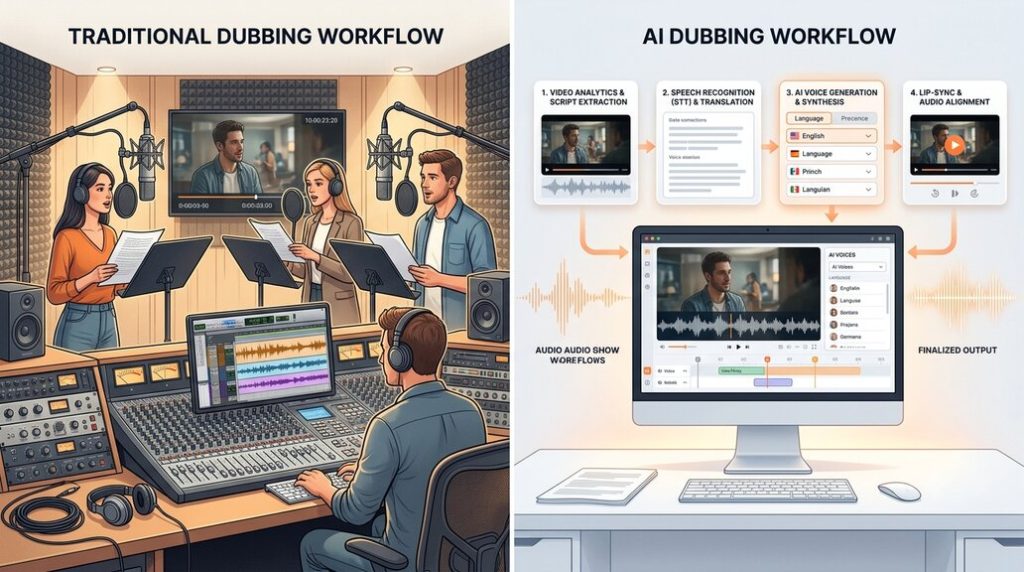
AI dubbing and traditional dubbing have different strengths.
| Factor | Traditional Dubbing | AI Dubbing |
|---|---|---|
| Translation | Human translators | AI-assisted translation |
| Voice | Professional voice actors | AI-generated voices |
| Production time | Usually longer | Usually faster |
| Cost | Can be expensive | Generally more scalable |
| Emotional direction | Human-controlled | AI-generated |
| Large number of languages | More difficult to scale | Easier to scale |
| Creative control | Very high | Depends on the platform |
| Human review | Common | Still recommended |
Traditional dubbing remains valuable for movies, television, premium advertisements, and other projects where every performance detail matters.
AI dubbing is especially attractive when speed, scale, and multilingual distribution are priorities.
In many cases, the best approach may not be choosing one over the other. A hybrid workflow can use AI for the first version and human professionals for translation review, pronunciation checks, editing, and final approval.
The Role of Text-to-Speech in AI Dubbing
Translation is only one part of the dubbing process. Once the original dialogue has been converted into another language, the translated script still needs to be turned into natural-sounding speech.
This is where AI text-to-speech (TTS) becomes important.
A text-to-speech system converts written text into spoken audio using an AI-generated voice. In an AI dubbing workflow, the translated script can be converted into a voice that matches the intended language, tone, and style of the content.
A simplified workflow looks like this:
Original Video → Speech Recognition → Translation → Script Review → AI Voice Generation → Audio Editing → Synchronization → Localized Video
Each step has a different purpose.
- Speech recognition converts the original dialogue into text.
- Translation converts the dialogue into the target language.
- Script review checks names, terminology, cultural references, and sentence structure.
- AI voice generation turns the translated text into spoken audio.
- Audio editing adjusts pauses, volume, pacing, and other elements.
- Synchronization helps the new voice fit the original video.
- Human review checks whether the final version sounds natural.
This is why AI dubbing should not be thought of as simply “translating a video.”
The translation has to work as spoken language, and the generated voice has to sound appropriate for the content.
How AI Dubbing Works: Step-by-Step
Although different platforms use different technologies, most AI dubbing workflows follow a similar process.
1. Speech is Converted Into Text
The first step is usually speech recognition.
The system analyzes the original audio and identifies what the speaker is saying. The resulting transcript becomes the foundation for the rest of the dubbing process.
Better transcription is important because an incorrect transcript can create problems later.
Names, technical terms, numbers, accents, and background noise can all affect transcription accuracy.
2. The Script is Translated
The transcript is then translated into the target language.
For simple sentences, automated translation can work well. However, videos often contain jokes, cultural references, technical terminology, product names, or informal expressions.
That means a translated script should ideally be reviewed before generating the final voice.
A good localized script should sound like something a person would naturally say in the target language, rather than a word-for-word translation.
3. The Localized Voice is Generated
Once the translated script is ready, AI voice technology can turn it into speech.
This is one of the most important stages because the quality of the generated voice has a direct impact on how the dubbed video feels.
Modern TTS systems can provide different voices, languages, accents, speaking styles, and controls for aspects such as speed and pitch.
For example, a creator producing an educational video may want a calm and clear voice, while a promotional video may require a more energetic delivery.
Platforms such as Speakatoo can be useful at this stage because their AI text-to-speech technology provides access to a large collection of voices and languages for generating voiceovers.
The important distinction is that TTS is one component of the complete AI dubbing workflow. The translation, editing, timing, and final video synchronization still need to be handled as part of the overall production process.
4. Timing and Synchronization
Generating the new voice is not the final step.
The new audio must fit the video.
Suppose the original speaker says a sentence in five seconds, but the translated version takes eight seconds to speak. Simply replacing the audio may cause the dialogue to continue after the speaker has stopped talking.
This is why timing matters.
AI dubbing systems and editors may adjust:
- Speaking speed
- Pauses
- Sentence length
- Audio timing
- Dialogue placement
- Background audio levels
- Transitions between speakers
The goal is not necessarily to make every translated sentence exactly the same length as the original.
The goal is to make the final video feel natural.
5. Human Review
Even advanced AI systems can make mistakes.
A human reviewer can identify problems that an automated system may miss, such as:
- Incorrect pronunciation
- Wrong names
- Awkward translations
- Cultural references
- Unnatural expressions
- Incorrect technical terms
- Strange pauses
- Emotional mismatch
For important commercial, educational, or professional content, human review remains valuable.
Why Multilingual Video Content Matters for Creators
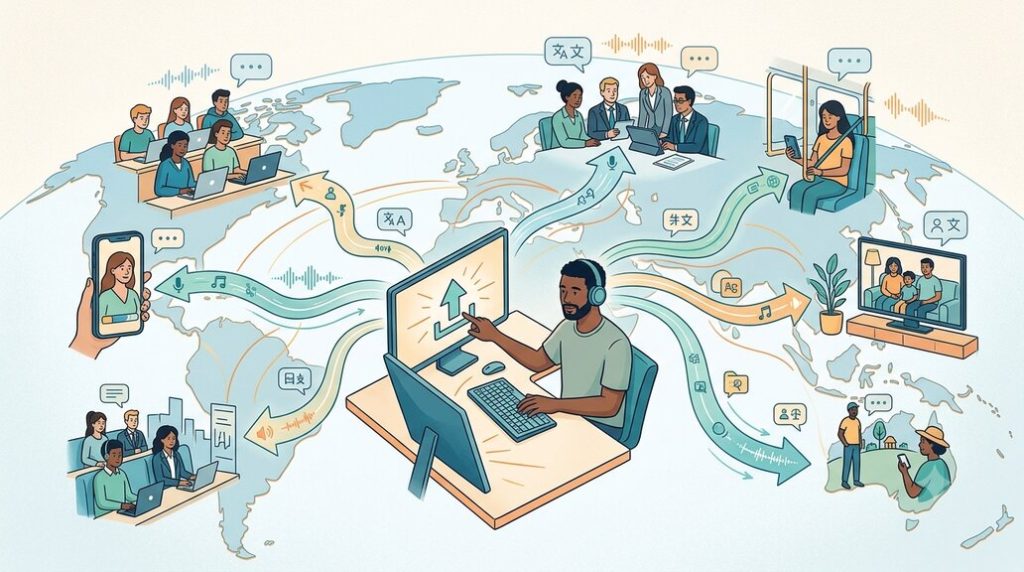
The biggest advantage of AI dubbing is not simply saving time.
It can change who can access a piece of content.
A YouTube creator might originally publish a video in English. Without dubbing, the creator is primarily communicating with people who understand English.
Adding subtitles can increase accessibility, but some viewers still prefer listening to content in their own language.
Dubbing creates another option.
A single video can potentially be made available in several languages without requiring the creator to record every version from scratch.
This can be especially useful for:
1. YouTube Creators
Creators can experiment with localized versions of their most successful videos instead of producing completely separate videos for every language.
2. Online Educators
Courses and tutorials can reach students who are more comfortable learning in their native language.
3. Businesses
Companies can localize product demonstrations, advertisements, tutorials, and customer education videos.
4. Marketing Teams
A campaign created for one market can be adapted for different regions without rebuilding the entire video from the beginning.
5. Software and Technology Companies
Product tutorials and onboarding videos can be made easier to understand for international users.
AI Dubbing and Regional Languages
One of the most interesting opportunities is the growth of content in regional and local languages.
The internet is no longer limited to English-speaking audiences.
Creators are producing content in languages such as Hindi, Bengali, Tamil, Telugu, Marathi, Gujarati, Punjabi, Malayalam, Kannada, and many others.
At the same time, audiences increasingly expect digital content to be available in languages they understand comfortably.
AI voice technology can help make this more practical.
For example, a creator could produce an educational video in English and then create localized voice versions for audiences who prefer Hindi or another regional language.
The same idea can apply to:
- Government and public information
- Educational content
- E-learning courses
- Product tutorials
- Health and awareness campaigns
- Local business advertising
- Social media videos
- Training materials
The opportunity is particularly important for creators who want to reach audiences outside their original language market.
AI Dubbing for YouTube Videos
YouTube is one of the clearest examples of why multilingual audio is becoming important.
A creator does not necessarily need to create a completely different video for every language.
The original visual content can remain largely the same while the audio is localized for different audiences.
This can be useful for videos such as:
- Tutorials
- How-to videos
- Explainer videos
- Educational lessons
- Product reviews
- Documentaries
- Technology content
- Travel videos
- Business videos
However, creators should not automatically dub every video into every available language.
A better approach is to identify where the audience is coming from.
For example, if analytics show that a significant number of viewers are from a particular country or language group, creating a localized version may make more sense than producing multiple versions without knowing whether there is demand.
AI Dubbing for Short-Form Content
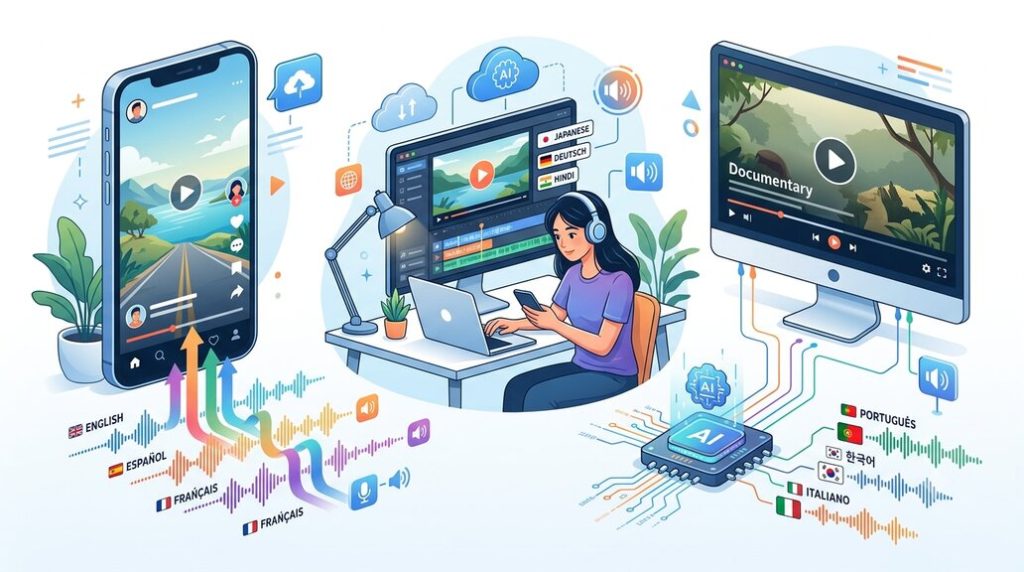
Short-form videos create another interesting use case.
Platforms such as YouTube Shorts, Instagram Reels, and TikTok have made short videos a major part of online communication.
Because short videos are often produced quickly, creators need efficient production workflows.
AI voice technology can help create localized voiceovers without requiring a new recording session for every language.
For example:
One Script → Multiple Translations → Multiple AI Voiceovers → Multiple Localized Videos
This does not mean every version will automatically be perfect.
Creators still need to check pronunciation, timing, captions, cultural context, and the overall quality of the localized content.
But the production process can become considerably more scalable.
What Makes an AI-Dubbed Voice Sound Natural?
Generating speech is relatively easy compared with generating speech that actually sounds appropriate.
A natural AI dub depends on several factors.
- Voice Quality: The voice should sound clear and consistent rather than robotic or overly artificial.
- Pronunciation: Names, locations, brands, and technical terms need to be pronounced correctly.
- Speaking Speed: A voice that speaks too quickly can make educational content difficult to follow. A voice that is too slow may make the video feel unnatural.
- Pauses: Human speakers naturally pause between ideas. Removing all pauses can make an AI voice sound unnatural.
- Emotion: A serious announcement should not sound cheerful. A promotional video may need more energy than a documentary.
- Context: The same sentence can sound different depending on what is being discussed.
This is why modern AI voice technology is moving beyond basic text-to-speech and toward more expressive speech generation.
Should AI Replace Traditional Dubbing?
Probably not in every situation.
AI dubbing is better understood as another production option.
For a creator who needs to localize a large number of educational videos into several languages, AI can provide enormous efficiency.
For a major film, premium advertisement, or emotionally demanding production, professional voice actors and human production teams may still be the better choice.
There is also a third option: hybrid dubbing.
In a hybrid workflow, AI can handle repetitive production tasks while humans focus on quality and creative decisions.
For example:
AI Translation → Human Review → AI Voice Generation → Human Editing → Final Approval
This approach can provide a balance between speed and quality.
How Creators Can Build a Better AI Dubbing Workflow
Creators who want to experiment with multilingual content can start with a relatively simple process.
Step 1: Choose a Strong Original Video
Start with content that already performs well or has clear potential in another market.
Step 2: Create a Clean Transcript
Review the original transcript before translation.
Correct names, numbers, terminology, and obvious transcription mistakes.
Step 3: Translate the Script
Translate the content into the target language while maintaining the original meaning and tone.
Step 4: Review the Translation
Do not immediately generate the final voice.
Check whether the translated script sounds natural when spoken.
Step 5: Select an Appropriate AI Voice
Choose a voice that matches the purpose of the video.
An educational video, advertisement, tutorial, and entertainment video may require completely different voice characteristics.
Step 6: Generate the Voiceover
Convert the localized script into speech using an AI text-to-speech system.
This is where a platform such as Speakatoo can become part of the production workflow, particularly when creators need multilingual AI voices and voiceover controls.
Step 7: Edit and Synchronize
Adjust the generated audio so that it fits the original video.
Step 8: Review the Final Video
Listen to the entire video rather than checking only individual sentences.
Small pronunciation or timing problems can become more obvious when the complete video is played.
Step 9: Publish and Measure
After publishing the localized version, monitor audience retention, watch time, engagement, and viewer response.
AI Dubbing vs Subtitles: Which One Should You Use?
Subtitles and dubbing solve the same basic problem in different ways.
| Factor | Subtitles | AI Dubbing |
|---|---|---|
| Audio remains original | Yes | No |
| Viewer needs to read | Yes | Less dependent on reading |
| Production complexity | Lower | Higher |
| Multilingual accessibility | Good | Very good |
| Useful for mobile video | Yes | Yes |
| Preserves original voice | Yes | Not necessarily |
| Suitable for educational videos | Yes | Yes |
| Suitable for immersive viewing | Moderate | High |
There is no universal winner.
Some viewers prefer subtitles because they want to hear the original speaker. Others prefer dubbed audio because they can watch without constantly reading text.
For many creators, offering both can provide the best experience.
Frequently Asked Questions About AI Dubbing
1. What is AI dubbing?
AI dubbing is the use of artificial intelligence to create a new voice track for existing video or audio content in another language. The process can involve speech recognition, translation, AI voice generation, audio processing, and synchronization.
2. Is AI dubbing the same as translation?
No. Translation changes the language of the content, while dubbing also requires generating spoken audio and fitting that audio into the original video.
3. Can AI dubbing preserve emotions?
Modern AI voice systems are becoming better at expressive speech, but the result depends on the technology, language, voice model, and original content. Human review may still be necessary for highly emotional content.
4. Can creators use AI dubbing for YouTube videos?
Yes. AI dubbing can be useful for creating localized versions of YouTube content, particularly educational videos, tutorials, explainers, and other content intended for international audiences.
5. Is AI dubbing better than traditional dubbing?
Not necessarily. AI dubbing can be faster and easier to scale, while traditional dubbing provides greater human control over performance. The right option depends on the content and production requirements.
6. Does AI dubbing work with regional languages?
AI voice and translation technologies increasingly support many regional and international languages. However, quality can vary by language, so creators should review pronunciation and naturalness before publishing.
7. Does Speakatoo provide AI voices for multilingual content?
Speakatoo is an AI text-to-speech platform that provides multilingual voices and voice-generation features. It can be used as the voice-generation part of a broader AI dubbing workflow.
8. Will AI dubbing replace voice actors?
AI dubbing may reduce the need for some repetitive voice-production tasks, but it is unlikely to eliminate the need for professional voice actors in every type of production. Human performance remains valuable when creative direction, character acting, and emotional nuance are important.
Conclusion
AI dubbing is making multilingual video content more accessible to creators, businesses, educators, and audiences.
The technology is not simply about translating words. A successful dubbed video requires a combination of accurate transcription, natural translation, high-quality AI voice generation, timing, synchronization, and human review.
Text-to-speech plays an important role because the translated script ultimately needs to become natural spoken audio. With multilingual AI voices and increasingly expressive speech technology, creators have more options for producing localized voiceovers without recording every version manually.
The biggest opportunity is scalability.
A video created for one language can potentially reach audiences in several others, opening the door to new viewers, customers, students, and communities.
AI dubbing will not make every production completely automatic, and traditional dubbing will continue to have an important place. But the technology is changing the economics and workflow of content localization.
For creators in 2026, the question may no longer be whether their content can reach another language audience.
It may be how many audiences their content can reach.