



Imagine receiving a phone call from your son, daughter, friend, or business partner. The voice sounds familiar, and the person seems frightened. They say they are in trouble and urgently need money. Because the voice sounds real, you may feel pressure to help immediately.
But what if the person speaking is not who you think they are?
AI voice cloning has made it possible to create artificial speech that closely resembles a real person’s voice. Although this technology has useful applications in content creation, accessibility, education, and communication, criminals can also misuse it to impersonate people and deceive their families, colleagues, or customers.
In 2026, understanding AI voice cloning scams is an important part of staying safe online. You do not need to become a technical expert to protect yourself. Learning how these scams work, checking suspicious requests independently, and protecting your personal audio can reduce the risk of becoming a victim.
This guide explains how AI voice cloning scams work, the warning signs to look for, practical ways to verify someone’s identity, and what to do if a cloned voice is used against you.
What is AI Voice Cloning?
AI voice cloning is a technology that uses artificial intelligence to create a synthetic version of a person’s voice. Depending on the technology and the quality of the available audio, the generated voice may reproduce characteristics such as tone, pitch, pronunciation, rhythm, and speaking style.
For example, a creator might use a voice clone of their own voice to narrate educational videos in multiple languages. Someone who has difficulty speaking may also use a personalized synthetic voice to communicate.
However, the same technology can be misused to make a person appear to say something they never said.
How does voice cloning work?
The process generally involves a few steps:
Collecting an audio sample: A system receives a recording of the person’s voice.
Learning voice characteristics: The AI processes characteristics of the sample, depending on the tool and its design.
Generating synthetic speech: The system produces new speech using the learned voice characteristics and supplied text or other inputs.
Using the generated audio: The resulting recording can be used in a video, voiceover, message, or, in some situations, an impersonation attempt.
The amount and quality of audio required vary between systems. Some voice-cloning services can work with short samples, which means criminals may not need access to hours of private conversations.
The US Federal Trade Commission (FTC) has warned that scammers can use short audio clips found online to create convincing imitations of family members. You can read its consumer guidance on AI-assisted family emergency scams.
Is AI voice cloning always dangerous?
No. Voice cloning itself is a technology, not automatically a scam.
Its legitimate uses include:
- Creating narration for videos and podcasts.
- Producing multilingual content.
- Supporting people who have lost or have difficulty using their natural voice.
- Developing accessible learning materials.
- Maintaining a consistent voice across approved business content.
- Creating authorized audio versions of written material.
The problem arises when someone uses a voice without appropriate permission, misrepresents synthetic speech as genuine, or uses it to commit fraud, harassment, or another harmful act.
How Do AI Voice Cloning Scams Work?
AI voice scams often combine technology with familiar social-engineering tactics. Instead of relying only on a suspicious message, the criminal uses a recognizable voice to make the request feel believable.
Here is a simplified example.
Suppose someone posts public videos on social media. A criminal obtains a recording, uses a voice-cloning system to create an imitation, and contacts a family member pretending to be that person.
The caller claims to have been involved in an accident and asks for immediate financial assistance. They may insist that the situation is confidential or that there is no time to verify the story.
The family member hears a familiar voice and becomes worried. If they transfer money before checking the claim, the scam may succeed.
The usual stages of a voice cloning scam
Step 1: Collecting information
The scammer looks for publicly available voice recordings, videos, personal details, or information about relationships and recent activities.
Step 2: Creating an imitation
A voice-cloning tool is used to generate audio resembling the target’s voice.
Step 3: Choosing a believable situation
The criminal invents an emergency, business request, payment problem, or other story that could persuade the victim to act.
Step 4: Creating urgency
The victim is told to send money quickly, share a verification code, reveal private information, or keep the situation secret.
Step 5: Preventing verification
The caller may discourage the victim from hanging up, contacting other family members, or speaking to the supposed person through another channel.
The most important lesson is that a familiar voice does not prove the caller’s identity. Verify the request independently before taking action.
Why Are Voice Cloning Scams a Growing Concern in 2026?
AI voice technology has become more accessible, and synthetic speech can be increasingly convincing. At the same time, people are accustomed to communicating through short voice notes, phone calls, video meetings, and social media recordings.
This creates several risks.
- Realistic voices can create false confidence: People naturally recognize familiar voices. When a caller sounds like a trusted person, a listener may focus on the emergency rather than question whether the call is genuine.
- Public recordings can reveal more than expected: Videos, livestreams, podcasts, interviews, and voice messages may provide audio that can be misused. Public content does not automatically make someone a suitable target, but it can give a criminal material to work with.
- Scams can combine several forms of impersonation: A criminal might use a cloned voice alongside a fake profile, a spoofed phone number, fabricated messages, or AI-generated video. Multiple signals can make an invented identity seem more credible.
- Emotional pressure can interfere with good decisions: Fear, excitement, embarrassment, and concern for loved ones can make people act before checking the facts. Scammers exploit these reactions by creating situations in which the victim feels that every second matters.
The FBI’s Internet Crime Complaint Center has warned that criminals use AI-generated audio to impersonate relatives and public figures, including in schemes designed to obtain money. Its guidance on AI-enabled financial fraud explains several ways these tools can be misused.
The Most Common Types of AI Voice Cloning Scams
Understanding common scam patterns can help you recognize a suspicious request before it becomes a financial or privacy problem.
1. Family emergency scams
A caller pretends to be a child, parent, grandparent, sibling, or another relative. They claim to be in an accident, facing arrest, stranded somewhere, or dealing with another emergency.
They ask for money immediately and may tell you not to contact anyone else.
How to protect yourself: End the call if necessary and contact the relative using a number already saved in your phone. If they cannot answer, contact another trusted family member. Do not rely on the caller’s voice alone.
2. CEO and workplace impersonation
A worker receives a voice message or call that appears to come from a manager, executive, or business partner. The caller requests an urgent bank transfer, confidential document, payroll change, or sensitive business information.
The request may appear credible because it uses the person’s name, speaking style, and knowledge of the workplace.
How to protect yourself: Follow your organization’s payment approval process. Verify unusual requests using a separate, established communication channel. A familiar voice must never replace financial controls.
3. Bank and customer support impersonation
A scammer pretends to represent a bank, payment service, government agency, or customer support team. They may ask for account information, a one-time password (OTP), a PIN, or remote access to a device.
AI-generated speech can make the call sound more professional, but the underlying warning signs remain the same.
How to protect yourself: Do not share passwords, PINs, or OTPs with an unsolicited caller. End the call and contact the organization using its official app, website, or a trusted number.
4. Celebrity voice and fake endorsement scams
Fraudsters use synthetic audio or manipulated videos to make it appear that a famous person recommends an investment, product, giveaway, or money-making scheme.
A recognizable voice is used to create trust, but the endorsement may be entirely fabricated.
How to protect yourself: Check the person’s verified channels and the company’s official website. Be suspicious of guaranteed profits, pressure to invest quickly, and requests to send money to an unfamiliar account.
5. Romance and online friendship scams
Someone you meet online may send voice notes that appear to confirm their identity. In some cases, a criminal may use cloned or synthetic audio to make a fake identity feel more personal and believable.
Over time, the person may request money for travel, medical treatment, an emergency, or an investment opportunity.
How to protect yourself: Do not send money merely because someone sends a familiar-sounding voice note. Be cautious about sharing financial information with people whose identities and circumstances you have not independently verified.
6. Fake audio messages and reputational attacks
A cloned voice may be used to make it seem that someone made an offensive statement, gave an instruction, or approved an action they never authorized.
Such material can damage personal relationships, professional reputations, and public trust.
How to protect yourself: Do not immediately forward or publish suspicious audio. Preserve the original message and its context, verify the claim through reliable channels, and report harmful impersonation to the relevant platform.
How to Recognize a Fake AI Voice
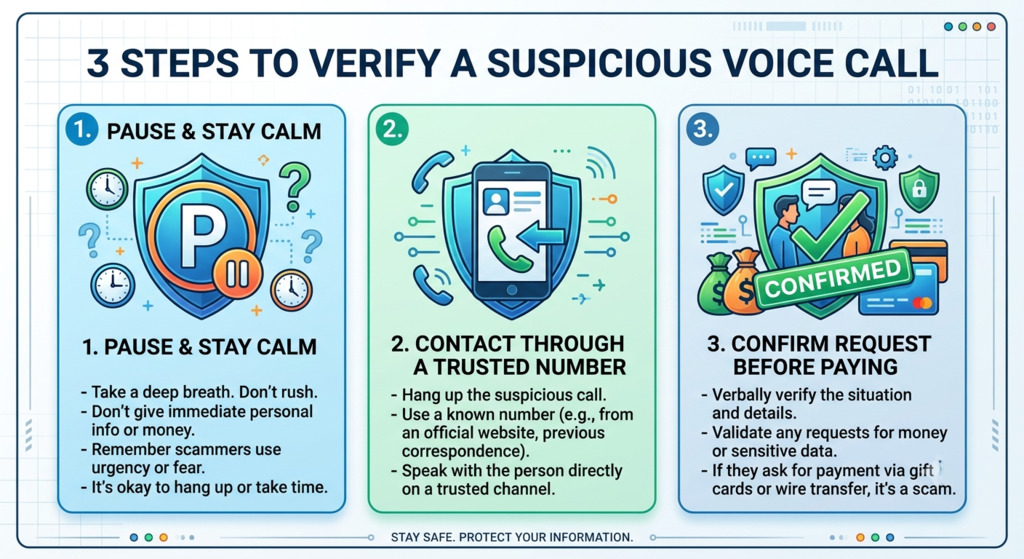
There is no single sound or listening trick that can reliably identify every AI-generated voice. Some synthetic audio contains noticeable problems, while other examples may sound very natural.
Instead of relying on one clue, look at the whole situation: the request, the caller’s behaviour, the communication channel, and whether the person’s identity can be independently confirmed.
Warning signs to pay attention to
| Warning sign | Why it matters |
|---|---|
| An unexpected request for money | The caller may be exploiting urgency or trust. |
| Pressure to act immediately | Scammers try to prevent independent checks. |
| Requests for secrecy | The caller may be trying to stop you from consulting someone else. |
| Unusual payment methods | Cryptocurrency, gift cards, or transfers to unfamiliar accounts can be warning signs. |
| A request for an OTP or password | Legitimate identity verification should not require you to disclose secret authentication codes to an unsolicited caller. |
| Refusal to allow a callback | The caller may be trying to control the conversation. |
| Details that do not match the real situation | The story may be fabricated or based on incomplete information. |
| Unexpected changes to payment instructions | This may indicate impersonation, whether or not AI is involved. |
10 Ways to Protect Yourself From Voice Cloning Scams
You cannot guarantee that nobody will attempt to imitate your voice. However, a few practical habits can make it much harder for a scammer to deceive you.
1. Create a family verification phrase
Agree on a private word or phrase that trusted family members can use to confirm their identity in an unexpected emergency.
Choose something that is not easily guessed from public social media posts. Keep it private and do not share it in public messages.
Remember that a verification phrase is only one safeguard. If a call still seems suspicious, independently contact the person.
2. Verify unexpected calls using a known number
If someone claims to be a relative or colleague and asks for money, hang up and call them using a number already saved in your contacts.
Do not simply call back the number that appeared on your screen or use a new number supplied by the caller.
If the person cannot be reached, try another trusted contact or a different established communication channel.
3. Never let urgency replace verification
A caller may claim that someone is injured, that a payment must be completed immediately, or that a business deal will fail unless you act at once.
Pause before responding. A genuine emergency can still be checked through a reliable channel.
Make it a personal rule: no unusual payment, disclosure of sensitive information, or account change without verification.
4. Protect your personal audio and videos
Review what you share publicly. Consider limiting access to personal videos, livestream recordings, and voice messages that reveal more than you intend.
You do not need to stop creating content. Instead, make thoughtful choices about which recordings are public, which accounts can view them, and how much personal information accompanies them.
5. Use strong account security
Protect email, social media, banking, and other important accounts with unique passwords and multifactor authentication where available.
Secure your email account especially carefully because it may be used to reset access to other services.
A cloned voice alone should not be treated as sufficient proof of identity for sensitive account changes or financial approvals.
6. Establish workplace verification procedures
Businesses should require additional verification for unusual payment instructions, changes to supplier bank details, payroll changes, and requests for confidential information.
Use dual approval for high-value transfers where appropriate. Confirm sensitive instructions through an independently established contact method rather than relying on a voice message.
These controls help protect against traditional impersonation scams as well as AI-assisted ones.
7. Be careful with OTPs, passwords, and banking details
Never disclose your password, PIN, or OTP just because a caller sounds familiar or claims to be from a trusted organization.
Do not install remote-access software or approve unexpected login prompts at a caller’s request.
If you are unsure, end the interaction and contact the relevant organization directly.
8. Confirm suspicious audio through another channel
If you receive an unexpected voice note from a friend, family member, executive, or public figure, verify the message through a separate channel.
For example, contact the person through their usual messaging account or saved phone number. If the audio asks for a payment, confirm the exact amount, recipient, and reason independently.
9. Limit unnecessary access to your accounts and devices
Keep your devices and apps updated. Review which apps can access your microphone and stored recordings, and remove permissions that are not needed.
Be cautious about unknown links, suspicious downloads, and services that request unnecessary access to personal files.
These steps do not prevent all voice cloning, but they can reduce other risks associated with account compromise and data collection.
10. Discuss voice scams with your family and team
A simple conversation can prevent a rushed decision later.
Explain that anyone can receive a convincing impersonation call and that pausing to verify a request is sensible, not rude. Agree on what to do if a caller claims there is an emergency.
For families, decide whom to contact first. For businesses, document a clear procedure for unusual payments and sensitive requests.
What to Do If Someone Clones Your Voice
Discovering that someone is using your voice without permission can be upsetting, particularly if the audio is being used to ask others for money or damage your reputation.
Take a calm, evidence-based approach.
Step 1: Save evidence
Keep copies of the suspicious audio, messages, account names, profile links, URLs, dates, and relevant screenshots. Preserve the original files where possible.
Do not edit or publicly redistribute the audio unnecessarily. If the incident may involve a crime, original evidence can help the platform or authorities investigate.
Step 2: Report the content to the platform
Use the relevant platform’s reporting process for impersonation, fraud, harassment, or manipulated media.
Include the specific account or content link and explain that your voice is being used without authorization. If the platform offers a dedicated impersonation or privacy process, follow its instructions.
Step 3: Warn people who could be targeted
If the fake voice is being used to contact your family, customers, colleagues, or followers, alert them through a trusted channel.
Keep the warning factual. For example, explain that an audio message asking for money does not come from you and that any unusual request should be confirmed directly.
Step 4: Secure your accounts
Change passwords if you suspect account compromise. Enable multifactor authentication, review recent account activity, and revoke unfamiliar sessions or app permissions.
If the scammer has accessed an email or messaging account, securing that account may be as important as reporting the cloned audio.
Step 5: Report the incident
If the voice clone is being used for fraud, threats, identity misuse, or other unlawful activity, consider reporting it to the appropriate law enforcement agency.
In India, you can file a complaint through the National Cyber Crime Reporting Portal. For financial cyber fraud, call 1930 as soon as possible. You should also contact your bank or payment provider immediately if money or financial credentials are involved.
The Government of India’s cybercrime portal provides official reporting information.
What to Do If You Have Already Lost Money
If you sent money because of a cloned voice or another impersonation scam, act quickly. Do not feel embarrassed or assume that nothing can be done.
Contact your bank or payment provider immediately. Explain that the transfer may be fraudulent and ask whether it can be stopped, recalled, or investigated.
In India, call 1930 for financial cyber fraud. Submit the relevant complaint through the National Cyber Crime Reporting Portal and follow the official instructions.
Save transaction information. Keep the transaction reference, amount, date, recipient details, messages, call records, and relevant audio.
Secure affected accounts. Change compromised passwords and contact your bank if your payment credentials or account access may have been exposed.
Report the impersonation. Notify the platform where the fake audio or profile appeared.
Be wary of recovery scams. Someone may contact you claiming they can recover the money for an upfront fee. Verify any such service independently and do not send more money to an unverified person.
Quick reporting may help the relevant institutions respond, but recovery is not guaranteed. Follow instructions from your bank and the authorities, and avoid making additional payments to the scammer.
How Content Creators Can Use Voice Cloning Responsibly
Voice cloning can help creators produce content more efficiently, especially when they want to maintain a consistent narration style across videos, courses, podcasts, or languages.
The key is to use it transparently and with appropriate authorization.
Get permission before cloning a voice
Use your own voice or a voice you have explicit permission to reproduce. If you are working with a voice actor, client, employee, or collaborator, clarify the intended use before creating the clone.
Permission should cover relevant details such as:
The purpose of the voice clone.
The platforms where it can be used.
Whether commercial use is permitted.
Whether the voice may be used in other languages.
How long the authorization lasts.
How the audio and voice data will be handled.
For business projects, record the agreement and establish who is responsible for approving the final output.
Avoid misleading audiences
If synthetic audio could reasonably lead an audience to believe that a person made a statement they never made, explain the context clearly.
Do not use a clone to fabricate endorsements, create fake testimonials, impersonate a public figure, or mislead customers.
Review every generated recording
Even authorized voice cloning can produce errors in pronunciation, emphasis, tone, or meaning. Listen to the final audio, check names and important facts, and make corrections before publishing.
Choose tools carefully
Review a service’s current privacy information, terms of use, account controls, and data deletion process. Understand what happens to uploaded recordings and how you can request removal if needed.
For example, Speakatoo’s voice cloning service supports creating synthetic speech from a voice sample. As with any voice-cloning service, users should use voices they own or are authorized to reproduce and check the service’s current terms and privacy information before uploading audio.
Frequently Asked Questions
1. What is an AI voice cloning scam?
An AI voice cloning scam involves using synthetic speech that imitates a real person’s voice to deceive someone. A scammer may pretend to be a family member, colleague, public figure, or trusted contact to request money, obtain sensitive information, or support another fraudulent activity.
2. Can someone clone my voice from a social media video?
Potentially, yes. Public videos, interviews, podcasts, and other recordings may provide audio samples that can be used by some voice-cloning systems. The amount and quality of audio required depend on the technology. Limiting unnecessary exposure of personal recordings can reduce opportunities for misuse, but it cannot guarantee complete protection.
3. How can I tell if a voice recording is AI-generated?
There is no universal listening test that identifies every cloned voice. Unusual pauses or pronunciation may be clues, but genuine audio can have similar characteristics. Verify the speaker’s identity independently, especially if the recording contains an urgent request for money or personal information.
4. Can scammers clone a voice from a short recording?
Some voice-cloning tools can generate an imitation from a relatively short sample. Requirements vary by tool, language, recording quality, and intended result. Do not assume that a short public recording is automatically harmless.
5. What should I do if a family member calls asking for urgent money?
Pause and independently contact the family member using a number already saved in your phone. If you cannot reach them, contact another trusted relative. You can also use a private verification phrase agreed upon in advance. Do not transfer money until you have verified the situation.
6. Can AI voice cloning bypass bank security?
A cloned voice may be used in attempts to impersonate someone, but whether it can bypass a particular security system depends on that system’s design and safeguards. Financial institutions should not rely on voice similarity alone for high-risk authentication. Individuals should never share passwords, PINs, or OTPs with unsolicited callers.
7. Is voice cloning illegal in India?
Not every use of voice cloning is automatically illegal. Legal consequences depend on the circumstances, applicable laws, consent, and the way the voice is used. Fraudulent impersonation or other harmful conduct may violate relevant laws. Seek legal advice for a specific situation.
8. What should I do if someone uses my voice without permission?
Save the relevant audio, messages, URLs, and account details. Report the content to the platform, warn people who may be targeted, and secure any accounts that could be compromised. If the voice is being used for fraud or threats, consider reporting it to the appropriate authorities.
9. Should I use an AI detector to check a suspicious voice recording?
A reputable detection tool may provide useful additional information, but it should not be your only source of evidence. Detection systems can make mistakes. Verify the speaker independently and assess the surrounding circumstances before deciding whether a recording is genuine.
10. How can businesses protect themselves from AI voice scams?
Businesses should establish clear approval processes for payments, bank-detail changes, account access, and confidential requests. Employees should independently verify unusual instructions through established contact channels. High-value transactions should follow documented security controls even when a request appears to come from a senior executive.
11. Is it safe to use a voice-cloning tool for content creation?
It can be appropriate when you have permission to use the voice, understand the service’s privacy practices, and follow the applicable terms and laws. Use your own voice or an authorized voice, review the output, and avoid creating misleading content.
12. What is India’s cybercrime helpline number for financial fraud?
In India, 1930 is the helpline for reporting financial cyber fraud. You can also use the National Cyber Crime Reporting Portal. If you have lost money, contact your bank or payment provider immediately as well.
Final Thoughts
AI voice cloning can make communication and content creation easier, but it can also give scammers another way to impersonate people and exploit trust.
The most effective protection is not trying to recognize every artificial voice by ear. It is building habits that make impersonation harder to succeed: verify unusual requests, use trusted contact details, protect personal recordings, establish family and workplace procedures, and act quickly if fraud occurs.
Remember three simple rules:
- Do not trust a voice alone.
- Verify before sending money or sharing sensitive information.
- Report suspected fraud as soon as possible.
For creators, the same technology can be useful when it is used with consent, transparency, and care. By understanding both its benefits and its risks, you can make better decisions about AI voice tools and help protect the people around you.