



Introduction: The Myth of the Global English Audience
For the past two decades, digital marketing and content creation operated under a quiet, unspoken rule: If you want to reach the world, publish in English. Creators built channels, brands launched multi-national product campaigns and educators uploaded video courses almost exclusively in standard US or UK English, assuming that global audiences would adapt.
That assumption is no longer valid.
While English remains a dominant global bridge language, consumer behavior data tells a completely different story. Users overwhelmingly prefer consuming content, purchasing products and interacting with customer support in their native regional mother tongue. Furthermore, they do not just want text translated; they want to hear natural speech delivered with authentic regional accents, correct cultural nuances and localized inflections.
This has triggered a massive shift toward hyper-localization. Powered by advanced multilingual text-to-speech (TTS) engines and regional voice libraries, businesses and creators can now bypass expensive dubbing studios and speak directly to localized demographics in their native tongue.

In this exhaustive, in-depth masterclass guide, we will explore why regional language text-to-speech is transforming digital engagement, how regional accents build psychological trust and how you can leverage platforms like Speakatoo to scale your hyper-localization strategy.
The Psychology of Mother Tongue Engagement
Why does hearing a message in a regional language or local accent create such an immediate psychological shift in a listener? The answer lies in cognitive science and human connection.
1. The Comfort of the Mother Tongue
When an individual encounters content spoken in their native language—whether it is Hindi in North India, Tamil in the South, Spanish in Latin America, or regional dialects across Europe—their cognitive load drops instantly.
Reduced Friction: Processing information in a second language requires active mental translation. Hearing content in a mother tongue lowers resistance, builds immediate trust and keeps the audience’s attention hooked for longer periods.
Cultural Resonance: Language carries culture. Specific idioms, expressions of warmth, respect markers (such as honorifics in Indian or Asian languages) and conversational rhythms establish an instant bond between the content creator and the listener.
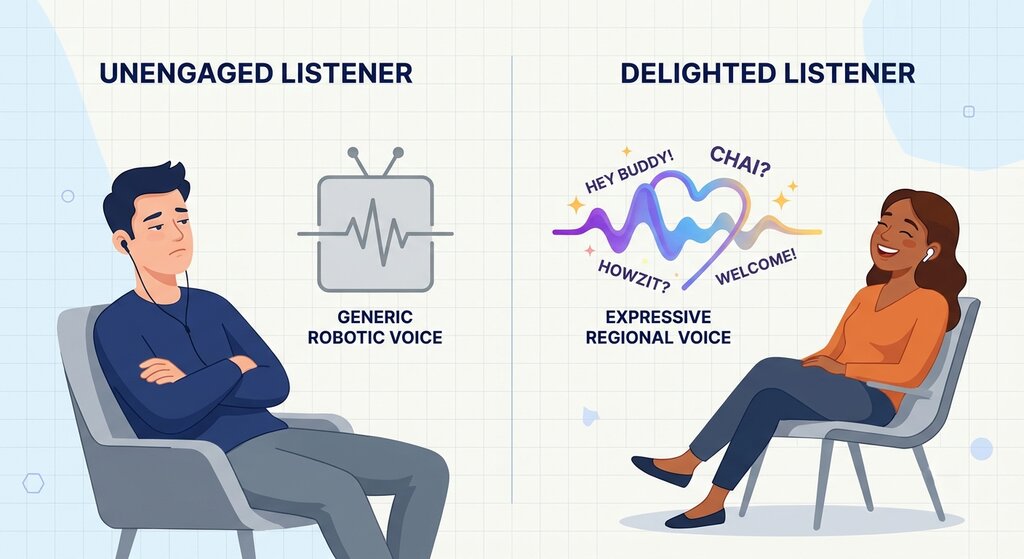
2. The Failure of Generic “One-Size-Fits-All” Accents
For years, early globalization efforts relied on a single, generic American or British AI voice applied universally across international markets.
The Alienation Effect: To a regional listener, hearing a heavy American accent attempt to pronounce local names, cities, or cultural contexts sounds unnatural and untrustworthy. It signals that the brand or creator did not invest the effort to understand their specific audience.
The Regional Advantage: Hyper-localization ensures that audio sounds native, respectful and culturally native.
The Explosive Growth of Regional Digital Markets
The demand for regional language content is not just a preference; it is driven by explosive economic and demographic shifts across major digital markets.
The Multi-Lingual Boom in India and Global South Economies
Take India as a prime example: while English-speaking internet users represent a significant share of digital commerce, the fastest-growing tier of internet users consists of regional language speakers across Tier-2 and Tier-3 cities consuming content in Hindi, Marathi, Bengali, Tamil, Telugu, Kannada, Gujarati and Punjabi.
Consumption Patterns: Data shows that regional audiences engage with video content, e-learning courses and e-commerce ads at rates exponentially higher than English-only campaigns.
The Content Deficit: While demand for regional content is massive, the supply of professionally produced audio and video in every regional dialect has historically lagged behind. This is where regional TTS acts as a superpower for creators and enterprises.
Technical Challenges in Regional Language Text-to-Speech
Developing natural-sounding regional text-to-speech models is infinitely more complex than standard English synthesis. Engineering teams must overcome distinct phonetic and linguistic hurdles.
1. Complex Phonetics and Conjunct Characters
Many regional languages (such as Devanagari script for Hindi/Marathi, Dravidian scripts for Tamil/Telugu, or Arabic script) feature complex conjunct characters, retroflex consonants and distinct breathing points that do not exist in English.
Phonetic Accuracy: Early TTS models struggled with these nuances, resulting in awkward clipping or mispronounced syllables. Modern neural TTS engines are trained on massive datasets of native speakers, mastering the subtle micro-pronunciations required to sound authentically human.
2. Code-Switching: The Modern Bilingual Reality
In everyday modern conversation—especially among younger demographics in global hubs—people rarely speak in a pure, isolated dictionary language. They code-switch, blending English and regional terms fluidly mid-sentence (e.g., “Aaj ka schedule thoda hectic hai” or Spanglish variants).
Seamless Blending: Modern multilingual TTS platforms excel at code-switching, rendering mixed-language scripts smoothly without stumbling or shifting into a robotic cadence halfway through a sentence.
Industry-by-Industry Applications of Regional TTS

The ability to generate broadcast-quality regional audio instantly transforms operational workflows across multiple business sectors:
1. E-Learning and EdTech Expansion
Educational platforms wanting to scale courses across different states or countries previously had to hire dozens of local voice artists for every subject.
Instant Scaling: EdTech companies can now convert textbook chapters, video tutorials and interactive quizzes into natural-sounding audio across 10+ regional dialects overnight, making education accessible to students in their mother tongue.
2. Localized Customer Support and IVR Systems
Traditional automated phone trees in regional markets often frustrate callers who are forced to navigate English menus or choppy, robotic prompts.
Empathetic Regional IVR: Deploying regional voice agents that greet customers in their native language with natural local warmth drastically improves customer satisfaction scores and reduces call drop-offs.
3. Regional Marketing and Social Media Ads
Brands running performance marketing campaigns can tailor video advertisements across different regional markets simultaneously, ensuring that a campaign running in South India sounds authentically local compared to a campaign running in the North.
How to Implement a Hyper-Localized Audio Strategy
Transitioning your content workflow to incorporate regional language text-to-speech requires a practical, step-by-step strategy. Follow this proven framework:
Step 1: Audience Data Audit
Analyze your website traffic, YouTube analytics, or customer demographics to identify which specific regional languages or international dialects represent your highest-growth opportunities.
Step 2: Script Adaptation and Cultural Localization
Do not run a literal word-for-word machine translation of your English script. Ensure a native speaker or localized AI prompt review adapts idioms, humor and cultural references so the script feels natural when spoken aloud.
Step 3: Voice Selection and Accent Matching
Choose voice profiles that match the demographic profile of your target audience (e.g., selecting professional, warm tones for corporate training or energetic, engaging tones for social media ads).
Step 4: Generation, Preview and Publishing
Generate your audio files, listen to sample paragraphs to verify natural pacing and correct regional pronunciation and publish your localized content across your distribution channels.
If you want to explore an extensive library of voices spanning 130+ languages and regional dialects, platforms like Speakatoo provide robust, user-friendly text-to-speech tools designed to scale your global reach. You can easily test out their voice generator directly through the Speakatoo Text-to-Speech Generator.
FAQs on Regional Language TTS & Hyper-Localization
Q1: What is hyper-localization in content creation?
Answer: Hyper-localization goes beyond basic translation by adapting content—including language, regional accents, cultural references and idioms—to deeply resonate with specific local audiences in their native mother tongue.
Q2: Why are regional language text-to-speech voices better than generic English voices?
Answer: Regional TTS voices eliminate the cognitive friction of translation, build immediate psychological trust and respect cultural nuances, resulting in significantly higher engagement and conversion rates among local audiences.
Q3: Can regional TTS tools handle complex scripts like Hindi, Tamil, or Arabic?
Answer: Yes. Advanced neural TTS platforms are trained on extensive native phonetic datasets, allowing them to render complex conjunct characters, retroflex sounds and local scripts with natural, flawless pronunciation.
Q4: What is “code-switching,” and do modern TTS tools support it?
Answer: Code-switching is the natural habit of blending two languages mid-sentence (such as mixing English and Hindi or Spanish). Top-tier TTS engines support seamless code-switching without breaking rhythm or sounding robotic.
Q5: How do regional accents impact digital marketing conversion rates?
Answer: Studies consistently show that consumers are far more likely to trust advertisements, explainer videos and customer support agents when communicated with in their local accent and native language.
Q6: Can I use regional TTS to scale educational courses (EdTech)?
Answer: Absolutely. EdTech platforms use regional text-to-speech to convert textbooks and video scripts into dozens of local languages overnight, making learning accessible to students across Tier-2 and Tier-3 regions.
Q7: How long does it take to generate regional audio files using AI?
Answer: Generating a fully synthesized, studio-quality audio track from a written script takes only seconds to minutes, depending on the length of the text.
Q8: Do I need separate voice actors for every regional market?
Answer: Not necessarily. With advanced multilingual TTS and voice cloning platforms, you can generate natural narration across 130+ languages and regional dialects instantly without booking external recording studios.
Q9: How can I ensure my translated script sounds culturally natural?
Answer: It is recommended to combine localized AI translation models with a brief human spot-check or native reviewer to ensure idioms, humor and local phrasing fit the target demographic perfectly.
Q10: How can I start testing regional language voices for my projects?
Answer: You can explore professional regional voice libraries by visiting Speakatoo, which offers an extensive ecosystem of text-to-speech tools supporting 130+ languages and dialects. Try their engine directly via the Speakatoo Text-to-Speech Generator.
Conclusion: Speak the Language of Your Audience
The era of relying solely on a single global language to drive international growth has officially passed. To capture the attention of modern digital consumers, creators and enterprises must meet their audience where they are—in their native mother tongue, delivered with authentic regional warmth and correct cultural cadence.
By embracing hyper-localization and advanced regional language text-to-speech, you unlock massive new growth markets, build deeper emotional connections and scale your brand identity across the globe with unprecedented ease.
Ready to transform your content with authentic regional voices? Head over to Speakatoo to explore thousands of natural AI voices across 130+ languages and start generating today.