



Introduction
If you have ever interacted with a customer support bot or an automated phone line over the last few years, you likely remember the distinct, painful awkwardness of the experience. You would ask a question, followed by two full seconds of dead air, followed by a robotic voice that plowed ahead oblivious to whether you tried to interrupt or clarify.
For years, that jarring delay was accepted as a technical limitation of AI. Not anymore.
We have crossed a major threshold in conversational intelligence. Today’s state-of-the-art voice agents operate at sub-second latencies (often under 100 to 150 milliseconds), matching the natural timing of human conversation. Driven by a massive architectural pivot away from legacy multi-step workflows toward native Speech-to-Speech (S2S) models, AI voice agents are finally shedding their robotic reputation.
In this deep-dive article, we will explore why milliseconds matter in voice tech, how native S2S models work under the hood and how businesses are utilizing low-latency voice engines to revolutionize customer engagement, live sales and interactive applications.
The Anatomy of Awkwardness — Why Legacy Pipelines Failed
To understand why modern low-latency voice agents feel so revolutionary, we first have to look at why old voice bots felt so broken.
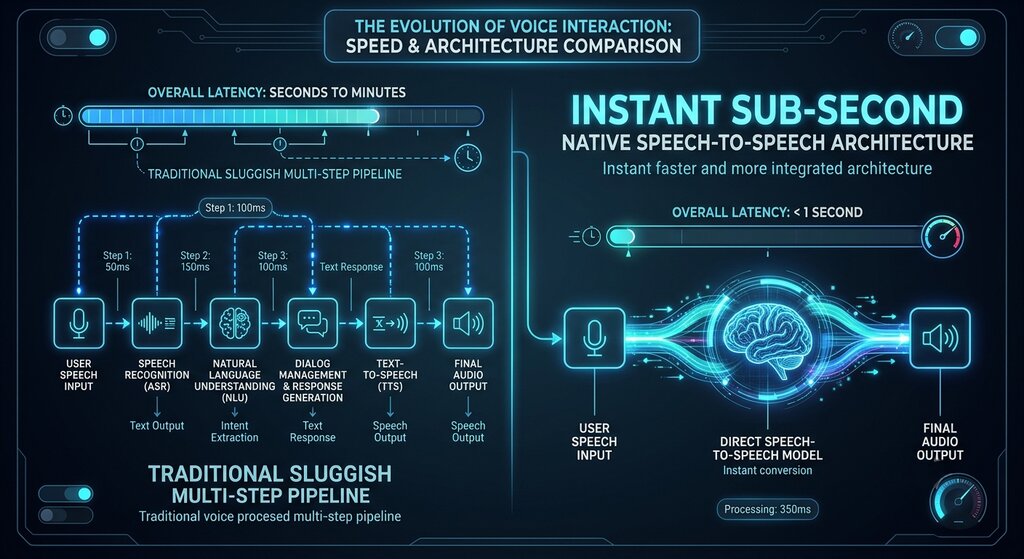
For a long time, conversational AI relied on a fragmented, multi-step process known as a cascaded pipeline (STT ➔ LLM ➔ TTS):
Speech-to-Text (STT): The system recorded your voice, transcribed the audio into text strings, and waited for you to finish speaking.
Large Language Model (LLM): The text was sent to an LLM, which processed the prompt and generated a text response.
Text-to-Speech (TTS): That text was finally passed to a separate text-to-speech engine to render audio files.
The Cost of the Chain
Every single hop in that chain added latency. By the time the audio buffer filled up and reached the user’s speaker, cumulative delays frequently hit 1.5 to 3 seconds (or worse). In human communication, a pause longer than a second shifts a conversation from natural dialogue to an awkward interrogation. Furthermore, because text strings stripped away all acoustic subtext, the resulting voice output lacked emotion, missed conversational cues, and completely failed to handle human interruptions (barge-ins).
The Native Speech-to-Speech (S2S) Revolution
The solution to the latency problem wasn’t just optimizing old code—it required an entire redesign of how models process audio. Enter native Speech-to-Speech (S2S) architectures and advanced real-time models (such as Cartesia Sonic and open-source foundations like MOSS-TTS).
How Native S2S Changes the Game
Instead of translating speech into text, processing text, and translating text back into speech, native S2S models process audio tokens directly alongside contextual intelligence.
Bypassing the Text Bottleneck: By handling audio tokens natively, these models eliminate intermediate translation steps, dropping time-to-first-audio metrics down to under 90 milliseconds.
Seamless Turn-Taking & Barge-Ins: Low-latency streaming architectures allow agents to detect when a user is changing their mind mid-sentence, pausing, or interrupting. The agent can instantly cut off its own audio stream and adapt—mimicking the fluid back-and-forth rhythm of an actual human conversation.
The Native Speech-to-Speech (S2S) Revolution
The solution to the latency problem wasn’t just optimizing old code—it required an entire redesign of how models process audio. Enter native Speech-to-Speech (S2S) architectures and advanced real-time models (such as Cartesia Sonic and open-source foundations like MOSS-TTS).
How Native S2S Changes the Game
Instead of translating speech into text, processing text, and translating text back into speech, native S2S models process audio tokens directly alongside contextual intelligence.
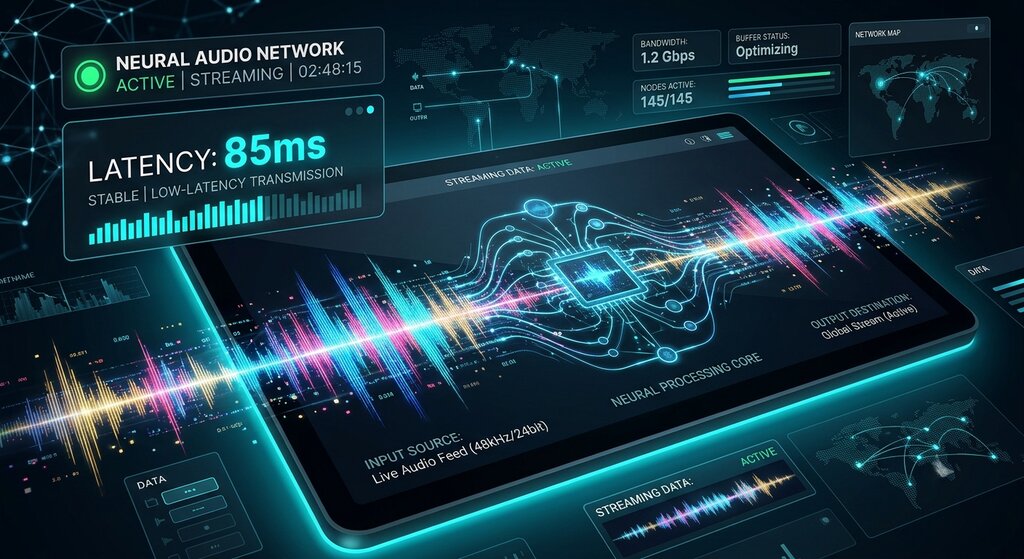
Bypassing the Text Bottleneck: By handling audio tokens natively, these models eliminate intermediate translation steps, dropping time-to-first-audio metrics down to under 90 milliseconds.
Seamless Turn-Taking & Barge-Ins: Low-latency streaming architectures allow agents to detect when a user is changing their mind mid-sentence, pausing, or interrupting. The agent can instantly cut off its own audio stream and adapt—mimicking the fluid back-and-forth rhythm of an actual human conversation.
Real-World Business Impact — Why Sub-Second Latency Matters
Speed is not just a vanity metric for developers; it fundamentally transforms user behavior and business conversion rates across multiple industries:
- Customer Support and Contact Centers: Traditional interactive voice response (IVR) phone trees are universally disliked because they waste time. Ultra-low-latency voice agents can authenticate callers, pull live account data from a knowledge base, and resolve billing inquiries instantly without frustrating hold times or unnatural pauses.
- Live Sales and Lead Qualification: In outbound sales or inbound inquiry routing, every second counts. Voice agents built on low-latency streaming can call back digital signups within seconds, engage them in natural dialogue, qualify their intent, and seamlessly book meetings into a CRM before the prospect loses interest.
- Interactive Training and Real-Time Coaching: Corporate training simulators and language-learning apps rely on responsive feedback. With sub-second voice generation, a trainee can practice high-stakes negotiation or customer service scenarios against an AI persona that reacts instantly to pushback, objections and curveballs in real-time.
Integrating High-Speed Voice Layers Into Modern Content Workflows
While real-time conversational agents require specialized WebSocket or streaming endpoints, content creators, marketers, and developers are also leveraging fast text-to-speech APIs to scale static and dynamic audio production.
When building or integrating modern voice infrastructure, look for platforms that offer:
Blazing-Fast Streaming Endpoints: Delivering audio in real-time through HTTP chunks or WebSockets rather than waiting for full file rendering.
Expressive Delivery & Emotional Cues: Ensuring that speed does not sacrifice natural pacing, intonation, or built-in non-verbal expressions (like laughter or intentional pauses).
Robust Voice Cloning & Localization: Seamlessly combining low-latency performance with instant voice cloning and multi-language support across global markets.
For platforms and creators looking to streamline high-speed, natural audio generation, solutions like Speakatoo offer robust ecosystems of advanced text-to-speech tools. You can easily test out their capabilities directly through the Speakatoo Speech-to-Speech Generator to bring smooth, professional narration into your workflow.
Frequently Asked Questions (FAQs) on Low-Latency Voice AI
To provide complete clarity for developers, creators, and business leaders exploring modern voice technology, here are answers to ten of the most trending questions:
Q1: What is “sub-second latency” in AI voice agents?
Answer: It refers to the time it takes for an AI system to process a user’s spoken input, generate a response, and start playing the audio back. Sub-second latency means this entire loop happens in under 1,000 milliseconds (typically targeting 100ms to 300ms), creating a natural conversational flow without awkward pauses.
Q2: How do native Speech-to-Speech (S2S) models differ from traditional TTS?
Answer: Traditional TTS uses a multi-step pipeline (Speech-to-Text ➔ Large Language Model ➔ Text-to-Speech). Native S2S models process audio tokens directly without converting them into intermediate text strings, drastically reducing latency and preserving vocal emotion, tone, and pacing.
Q3: Can low-latency voice agents handle user interruptions (“barge-ins”)?
Answer: Yes. Because streaming S2S pipelines process audio in continuous data chunks, the system can instantly detect if a user speaks while the AI is talking, immediately cutting off its own audio stream to listen and adapt.
Q4: Are low-latency models suitable for long-form audiobook narration?
Answer: Not primarily. Real-time models prioritize speed and low latency (TTFB) over deep artistic expression, whereas long-form narration models prioritize rich emotional nuance, loudness control, and consistent pacing over raw speed.
Q5: How do businesses integrate real-time voice agents into existing phone systems?
Answer: Businesses typically integrate voice AI platforms via SIP (Session Initiation Protocol) trunks or WebRTC (Web Real-Time Communication) APIs, connecting cloud-based S2S models directly to enterprise contact center software or cloud telephony providers.
Q6: What hardware is required to run ultra-fast on-device voice models?
Answer: Lightweight edge models (under 100M parameters) can run locally on modern smartphones, automotive chips, and embedded hardware using localized neural processing units (NPUs) without needing continuous cloud connectivity.
Q7: Does fast audio generation sacrifice voice cloning quality?
Answer: Not necessarily. Modern zero-shot cloning architectures can ingest a 10-to-15-second reference audio sample and map its speaker embedding into a low-latency streaming pipeline, allowing cloned voices to speak in real time.
Q8: How do platforms prevent security spoofing in voice-activated phone systems?
Answer: Enterprise voice agents integrate biometric voice verification and challenge-response protocols (asking callers to say specific randomized phrases) to authenticate user identity before executing sensitive account actions.
Q9: Can real-time voice agents switch languages mid-conversation?
Answer: Yes. Advanced multilingual S2S models support code-switching, allowing them to detect and seamlessly switch between languages or regional accents if a user changes languages mid-sentence.
Q10: How can I test high-speed text-to-speech tools for my own projects?
Answer: You can explore professional, high-performance platforms like Speakatoo, which offer robust text-to-speech generation tools designed for seamless integration and top-tier audio quality. You can try their engine directly via the Speakatoo Text-to-Speech Generator.
Conclusion: The Era of Seamless Audio is Here
The psychological threshold for conversational technology is unforgiving. If a response takes too long, the illusion breaks, and users immediately disengage. By breaking past the multi-second latency barrier through native speech-to-speech architectures and ultra-fast streaming models, the AI industry has turned voice agents from clumsy novelties into seamless, intelligent collaborators.
Whether you are building live customer service automation or scaling global content production, embracing low-latency, expressive audio technology is the key to staying ahead in a fast-moving digital world.
Ready to experience studio-grade, responsive audio generation for your projects? Head over to Speakatoo to explore advanced text-to-speech tools and elevate your content strategy today.