



Introduction: Breaking Down Language Barriers in the Digital Age
Content creation is no longer constrained by geography. A creator sitting in a studio in New York, a marketer running a campaign in Berlin, or an educator publishing video modules in Tokyo can instantly distribute their message worldwide. Yet, despite the borderless nature of the internet, a massive bottleneck has historically persisted: language and cultural localization.
For years, scaling media globally required hiring teams of translators, booking expensive foreign recording studios, casting local voice-over talent for every target market, and waiting weeks or months for post-production audio editing. If you wanted your content available in Spanish, Japanese, French, and Hindi, the financial and logistical hurdles were immense.
Today, that old paradigm has been completely shattered by multi-modal AI pipelines. By combining Speech-to-Text (STT), Advanced Neural Machine Translation, and Zero-Shot Voice Cloning / Text-to-Speech (TTS), creators and enterprises can establish a seamless loop. You can take an original English video, transcribe it, translate it into dozens of languages, and re-synthesize it in your exact same voice—retaining your unique acoustic identity, cadence, and emotional delivery—in a matter of minutes.
In this exhaustive, in-depth masterclass guide, we will explore how the multi-modal content loop works, examine the underlying technologies, break down step-by-step production workflows, and show you how to leverage platforms like Speakatoo to scale your global reach effortlessly.

What is a Multi-Modal Localization Loop?
To understand why this workflow represents a quantum leap forward, we must first define what “multi-modal” means in the context of modern media production.
Moving Beyond Single-Format Constraints
Traditionally, content processing was siloed. Text tools only handled text; audio tools only processed audio; translation tools operated strictly on static strings.
The Multi-Modal Approach: Modern artificial intelligence pipelines accept and transform multiple data types simultaneously. An audio track or video file is ingested, broken down into semantic meaning, translated contextually, and re-rendered as spoken audio while preserving visual lip-sync markers or emotional metadata.
The Localization Loop: Instead of recreating content from scratch for every foreign market, the multi-modal loop automates the transformation lifecycle: Audio/Video Ingest ➔ Speech Transcription ➔ Contextual Translation ➔ Synthetic Voice Cloning & Generation ➔ Final Export.
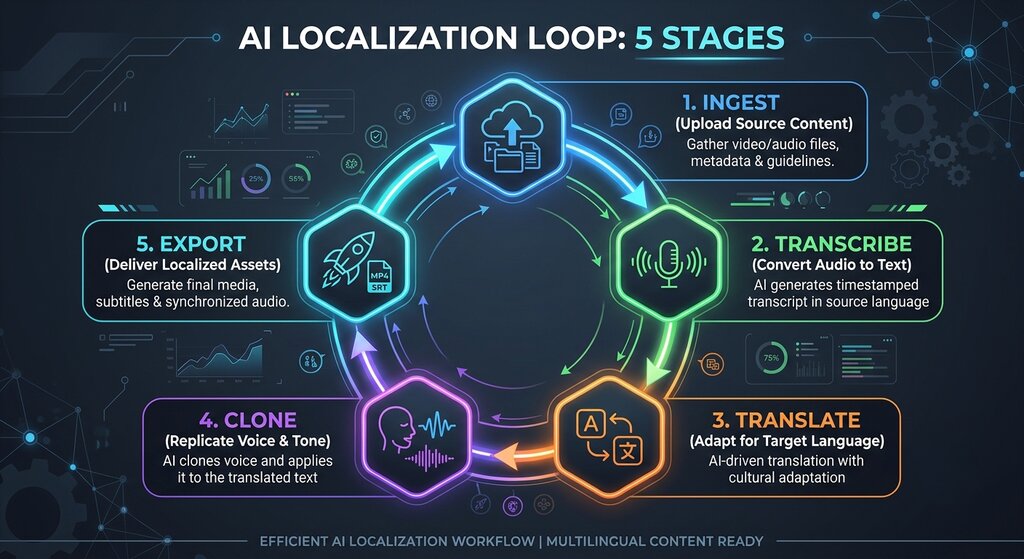
Step 1 of the Loop — Accurate Speech-to-Text (STT) Transcription
Every successful localization pipeline begins with flawless source transcription. If your initial speech-to-text engine misinterprets technical terms, names, or industry slang, every subsequent translation and voice generation step will inherit those errors.
The Evolution of Automatic Speech Recognition (ASR)
Modern ASR models leverage massive neural networks trained on thousands of hours of multi-accented audio.
Speaker Diarization and Noise Suppression: Advanced STT models can isolate a primary speaker from background noise, filter out acoustic interference, and separate multiple speakers in a dialogue.
Punctuation and Contextual Parsing: Unlike older transcription tools that spat out raw, unpunctuated blocks of text, modern transcription engines insert commas, periods, and conversational breathing markers. This is vital because punctuation signals to downstream text-to-speech engines where natural pauses belong.
Step 2 of the Loop — Contextual Translation and Cultural Adaptation
Translating content across global markets is about much more than a word-for-word dictionary swap. Literal translations often fail because they miss idioms, cultural nuances, and regional humor.
Neural Machine Translation Meets Large Language Models
Beyond Literal Translation: Modern translation layers powered by LLMs understand subtext and intent. If an idiom or marketing hook in English does not translate directly into Japanese or Spanish, the AI adapts the phrase to convey the identical psychological impact in the target culture.
Maintaining Tone and Formality: Depending on your target audience—whether it is corporate B2B training or casual entertainment for Gen Z—translation layers can dynamically adjust formality levels, regional slang, and local idioms to match your brand voice.
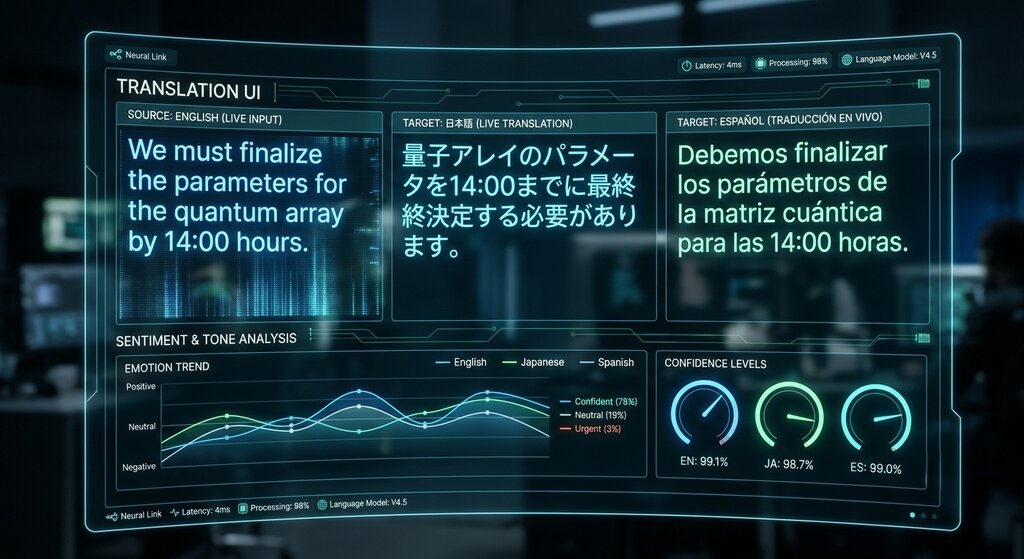
Step 3 of the Loop — Zero-Shot Voice Cloning & Multi-Lingual TTS
This is where the magic of the multi-modal loop happens. Once your content has been transcribed and translated into a target language, how should it sound?
Retaining Your Acoustic Identity Across Languages
In the past, dubbing a video into five different languages meant hiring five different voice actors whose voices sounded nothing like the original creator.
Cross-Lingual Voice Cloning: Today’s advanced voice cloning technology allows a creator’s unique vocal fingerprint (pitch profile, timbre, resonance, and pacing style) to be mapped across multiple foreign languages.
The Result: When your Spanish or German audience listens to your localized video, they are hearing your distinct voice speaking fluent Spanish or German, maintaining total brand consistency and personal connection worldwide.
Real-World Use Cases — Who Benefits Most from the Multi-Modal Loop?
The ability to rapidly localize content through integrated AI tools transforms operational workflows across multiple industries:
- Global YouTube Creators and Podcasters: Creators can expand their subscriber base exponentially by translating their top-performing videos into Spanish, Portuguese, Hindi, and Japanese. By maintaining their own cloned voice in every language, they preserve their core subscriber loyalty without needing to learn foreign languages or spend thousands on dubbing studios.
- Enterprise E-Learning and HR Training: Multinational corporations frequently struggle to roll out consistent compliance training and onboarding modules across international offices. With multi-modal translation pipelines, a single master training video can be instantly localized into dozens of regional languages, complete with professional narration that matches corporate brand standards.
- Global E-Commerce and Product Marketing: Brands launching new products can scale localized video advertisements across global social media platforms simultaneously, ensuring rapid market entry and culturally tailored messaging without logistical delays.
How to Build Your Own Multi-Modal Content Pipeline
Integrating a multi-modal localization workflow into your business or content creation schedule does not require a massive software engineering team. By leveraging existing modular platforms, you can build a streamlined production loop.
Step 1: Content Audit and Asset Preparation
Catalog the video, audio, and written assets you want to globalize. Ensure your source audio is clean and free of heavy background music or overlapping sound effects so transcription and cloning models can isolate the primary voice cleanly.
Step 2: Transcription and Translation Review
Run your source file through an automated transcription and translation pass. Always incorporate a quick human-in-the-loop review stage to verify that technical terms, brand names, and idioms translated accurately.
Step 3: Voice Cloning and Multi-Lingual TTS Generation
Select your target languages and apply your cloned voice profile. Fine-tune emotional tags, pacing sliders, and emphasis markers to ensure the synthesized output matches the dramatic arc of your original script.
Step 4: Final Integration and Publishing
Export your localized audio tracks, sync them with your video editing software, and publish your multi-lingual assets across your distribution channels.
If you want to experience studio-grade audio generation, text-to-speech, and voice tools firsthand, platforms like Speakatoo provide a comprehensive ecosystem designed to streamline localization and content creation. You can explore their robust toolset directly through the Speakatoo Text-to-Speech Generator.
Advanced Engineering Considerations for Enterprise Localization
When scaling multi-modal pipelines across thousands of hours of video or enterprise audio libraries, engineering teams must address several technical variables to maintain high output standards.
1. Managing Token Latency and Batch Processing
Enterprise-grade localization requires handling large volumes of script data concurrently. Utilizing batch processing endpoints rather than single-request HTTP queries ensures that massive translation queues process overnight without timing out.
2. Acoustic Match and Pitch Normalization
Different languages carry different syllable structures and pacing lengths. For instance, Spanish translations frequently run 20% longer in word count than their English source scripts. Advanced text-to-speech engines incorporate time-stretching and prosody matching algorithms to prevent the translated audio from rushing or sounding out of sync with video timelines.
Overcoming Common Pitfalls in AI Localization
While multi-modal pipelines offer incredible speed, failing to account for certain technical limitations can compromise output quality.
- The Literal Translation Trap: Relying solely on machine translation without checking cultural idioms can lead to embarrassing marketing errors. Always pair automated translation workflows with a native speaker spot-check or localized LLM prompt adjustments.
- Background Noise Interference: If your source audio contains heavy ambient music or sound effects, transcription models may hallucinate text or merge music into the dialogue transcript. Clean up your audio stems before feeding them into the multi-modal pipeline.
Frequently Asked Questions (FAQs) on Multi-Modal Localization & AI Voice
Q1: What is a multi-modal content loop in AI?
Answer: It is an automated workflow where different AI modalities (Speech-to-Text, Large Language Models for translation, and Text-to-Speech voice cloning) work together in a continuous loop to convert audio or video content from one language into multiple localized languages while preserving the original speaker’s voice.
Q2: Can I clone my voice in one language and have it speak another language?
Answer: Yes. Modern cross-lingual voice cloning architectures allow a voice sample recorded in English to speak fluent Spanish, French, Japanese, or dozens of other languages while retaining your unique vocal tone and timbre.
Q3: How accurate is AI speech-to-text transcription before translation?
Answer: Leading ASR models achieve over 95% to 98% transcription accuracy in major languages, especially when processing clean studio audio. However, a brief human review is recommended to catch rare brand names or technical jargon.
Q4: Does AI translation handle cultural idioms and slang?
Answer: Advanced neural translation models powered by LLMs go beyond literal word-for-word translation, adapting idioms and colloquialisms to fit the cultural context of the target audience.
Q5: How long does it take to localize a video using AI pipelines?
Answer: What used to take weeks with traditional dubbing studios can now be accomplished in minutes. Translating, cloning, and generating a 10-minute video into a new language can take as little as 5 to 10 minutes depending on server processing speeds.
Q6: Will my localized video match my exact lip movements?
Answer: While standard TTS and voice cloning generate standalone audio tracks, many modern pipelines pair multi-lingual audio with AI lip-sync tools to align visual mouth movements with the newly translated speech.
Q7: Are there security and privacy risks when uploading voice samples for cloning?
Answer: Reputable platforms enforce strict data privacy and encryption standards, ensuring your voice training data is secure and never used for unauthorized model training without your explicit consent.
Q8: Can I use AI voice cloning for commercial advertisements?
Answer: Yes, provided you have legal ownership or explicit licensing rights over the voice being cloned. Using cloned voices of public figures or unconsented individuals commercially violates right-of-publicity laws.
Q9: How many languages can modern TTS platforms support?
Answer: Top-tier platforms support anywhere from 50 to 130+ languages and regional dialects, including complex regional variations and code-switching capabilities.
Q10: How can I start localizing my content today?
Answer: You can test out professional tools and natural voice generation by visiting Speakatoo, where you can explore an extensive library of voices and features designed to scale your global reach. Try their engine directly via the Speakatoo Text-to-Speech Generator.
Conclusion: Scale Without Borders
The ability to communicate across borders is no longer restricted by expensive studio budgets or language limitations. By adopting the multi-modal content loop—seamlessly connecting speech recognition, contextual translation, and zero-shot voice cloning—creators and global enterprises can scale their message to billions of new listeners overnight.
Whether you are building an international educational channel, expanding your corporate training footprint, or localizing social media marketing campaigns, embracing multi-modal AI workflows is the definitive key to dominating the digital landscape.
Ready to transform your content strategy and speak to the world in your own voice? Head over to Speakatoo to explore advanced text-to-speech and localization tools today.